Mother of the House
Analysis On What Makes the Queen, One of One
In the realm of entertainment, few names resonate as powerfully as Beyoncé Knowles-Carter. The global icon has not only redefined the music industry but has become a symbol of empowerment, creativity, and cultural influence. Beyond the mesmerizing performances and chart-topping hits, delving into the data surrounding Beyoncé unveils a narrative of unparalleled success, societal impact, and a career trajectory that continues to defy expectations.
Beyoncé’s discography is not just a journey through melodies; it’s an exploration of sonic evolution, genre-defying creativity, and a profound influence on the global music landscape. In this data-driven exploration, I leverage the Spotify API to dissect the intricacies of Beyoncé’s musical identity, examining her music style, streaming metrics, and the diverse array of songs and albums that form the backbone of her illustrious career.
It’s important to note that in the data cleaning process, certain decisions were made to ensure the integrity of the analysis. ‘Homecoming: The Live Album’ was removed to eliminate duplicate songs. Additionally, any song on which Beyoncé did not provide vocals on in any of her albums, primarily ‘The Lion King: The Gift [DELUXE],’ were excluded. The focus was primarily on studio albums and songs in which Beyoncé served as a vocalist, not just as a songwriter. For example, songs like ‘MY POWER’ were retained in the analysis, while ‘JA ARA E’ was removed. Finally, “Beyonce Interlude” from Dangerously In Love, a 0:16 second interlude, was also removed from the analysis as well.
RENAISSANCE: Most Streamed Album
In the realm of Beyoncé’s discography, a deep dive into her Spotify data unveils fascinating insights into the streaming dynamics of her albums. The visualization below depicts the number of log streams per album, shedding light on the distinct patterns of listenership across her prolific career. “RENAISSANCE” claims the throne as Beyoncé’s most streamed album, on average. However, what truly distinguishes “RENAISSANCE” is not just its staggering popularity but also the intriguing consistency in streaming numbers across its tracks. The notably low variation (σ2 = .44) between streams suggests a compelling narrative—listeners are immersing themselves in “RENAISSANCE” as a cohesive body of work. Unlike albums with more erratic streaming patterns, like “Dangerously in Love” (σ2 = 2.79) or “I AM… SASHA FIERCE,” (σ2 = 2.16) it appears that fans are savoring the entirety of “RENAISSANCE” from start to finish, eschewing the tendency to skip around individual tracks. This phenomenon not only attests to the enduring allure of Beyoncé’s musical artistry but also underscores the album’s UNIQUE capacity to captivate audiences in a continuous, uninterrupted flow—a testament to the album’s seamless cohesion and the artist’s mastery in crafting a compelling musical narrative.
*if viewing on mobile, rotate your phone horizontal to enhance your experience with the interactive plot*
In an effort to explore the uniqueness of ‘RENAISSANCE,’ I was curious whether the release date of an album, either before or after the advent of Spotify, influenced its streaming performance. To do this, I utilized a linear mixed-effects model as to account for the hierarchical structure of the data, where log streams are grouped by albums. By including a random intercept for each album, I account for album-specific variations in streaming behavior, which is valuable when dealing with correlated observations within albums and unequal group sizes. Additionally, the model’s fixed effects incorporated other relevant variables, such as ‘valence’, ‘danceability’, ‘energy’, ‘loudness’, ‘speechiness’, ‘acousticness’, ‘instrumentalness’, and a dummy variable of whether album was release before or after the emergence of Spotify (2011), to control for potential confounding factors.
The model found there to be no statistically significant difference in the number of log streams between albums released before or after Spotify, suggesting that the timing of album releases in relation to Spotify’s presence does not play a discernible role in driving streaming numbers. The model, which as mentioned, controlled for various musical characteristics and album-specific effects, underscores that ‘RENAISSANCE’ continues to captivate audiences in a unique way regardless of its release date.
*if viewing on mobile, rotate your phone horizontal to enhance your experience with the interactive plot*
Mapping Beyoncé’s Discography
Beyoncé’s discography is a rich tapestry woven with diverse themes, from empowerment anthems to soulful ballads. Leveraging Spotify’s API, I delve into the nuances of her songwriting and production choices. Are there discernible patterns in the types of songs she creates? How do her albums vary in terms of style and thematic content? To do this, we plot the Queen’s music against two metrics, valence and energy.
At the intersection of music analysis and psychological theory, the exploration of Beyoncé’s songs through a scatter plot of energy and valence adds a layer of depth rooted in the Two-Factor Theory of emotion. This analytical approach aligns with the theory’s fundamental premise that emotions arise from a combination of physiological arousal and cognitive interpretation. In the musical context, energy serves as a proxy for the physiological arousal, reflecting the dynamic and visceral qualities of each composition. Meanwhile, valence encapsulates the cognitive interpretation, indicating the emotional tone, whether positive or negative. By applying the Two-Factor Theory to Beyoncé’s discography, we embark on a journey to unveil not just the rhythmic and melodic intricacies but also the emotional narratives embedded in her music. This method not only validates the analysis but enriches our understanding, acknowledging that the interplay between physiological response and cognitive appraisal contributes profoundly to the emotional richness inherent in each of Beyoncé’s musical creations.
*if viewing on mobile, rotate your phone horizontal to enhance your experience with the interactive plot*
Valence, is a measure from 0.0 to 1.0 describing the musical positiveness conveyed by a track. Tracks with high valence sound more positive (e.g. happy, cheerful, euphoric), while tracks with low valence sound more negative (e.g. sad, depressed, angry).
Energy is a measure from 0.0 to 1.0 and represents a perceptual measure of intensity and activity. Typically, energetic tracks feel fast, loud, and noisy while less energetic tracks feel slower or mellower. Perceptual features contributing to this attribute include dynamic range, perceived loudness, timbre, onset rate, and general entropy.
What Makes a Song Soar in the BeyHive?
When it comes to Beyoncé’s music, what sets certain songs soaring while others languish in the background? Are there specific elements within her catalog that have the power to propel a song to greater streaming heights? To help answer this question, I used a Random Forest model to unveil the crucial factors that shape the popularity of her music.
Among the top most influential features, ‘speechiness:acousticness’ emerges as the frontrunner, an interaction term, as her most important feature to her streaming. This intriguing blend of lyrical clarity and acoustic qualities evidently resonates deeply with listeners, making it the driving force behind Beyoncé’s most-streamed songs. ‘Danceability:energy’ follows closely at 98.75%, underscoring the importance of vibrant rhythms and a vivacious musicality. ‘Loudness’ holds its ground at 83.58%, emphasizing the significance of sonic intensity. Furthermore, the dynamic interplay between ‘energy:valence’ (78.56%) and ‘acousticness’ (78.30%) adds layers of depth to the appeal of Beyoncé’s music. ‘Acousticness:tempo’ (77.66%) contributes significantly, shedding light on the fusion of acoustic qualities and tempo dynamics that captivate her audience.
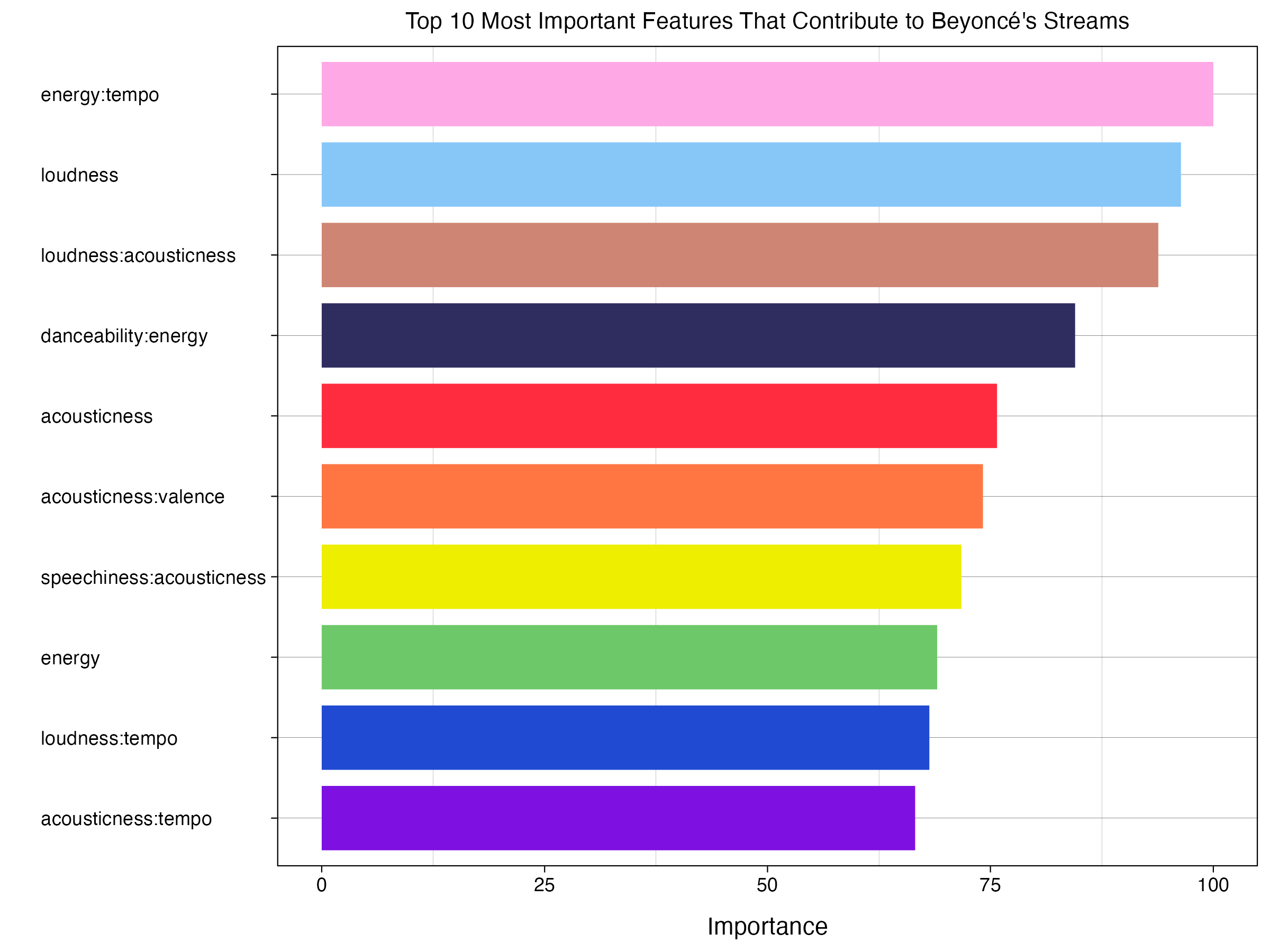
In summary, these top features shed light on the winning formula behind Beyoncé’s chart-topping tracks. They emphasize the synergy of lyrical clarity, energetic rhythms, sonic intensity, and the right balance of acoustic qualities and tempo dynamics. One might argue that the model suggest that Beyoncé’s fans (the Hive) are drawn to songs that offer a harmonious blend of these elements, and ultimately help explain the unparalleled popularity of her music.
Conversely, the analysis unveils the less impactful features in Beyoncé’s song streams, primarily characterized by instrumental aspects. ‘Instrumentalness:valence’ claims the lowest position at 0%, closely followed by ‘acousticness:instrumentalness’ (2.87%) and ‘loudness:instrumentalness’ (3.30%). These findings suggest that Beyoncé’s audience gravitates towards songs featuring vocal and emotional elements over purely instrumental compositions. Furthermore, ‘speechiness:instrumentalness’ (3.91%), ‘energy:instrumentalness’ (4.62%), and ‘danceability:instrumentalness’ (7.24%) underscore this vocal preference. While ‘instrumentalness’ itself (9.40%) holds a more modest position, it sheds light on the nuanced role of instrumental characteristics in song popularity, revealing that some listeners appreciate the presence of vocal content even in instrumental tracks. ‘Instrumentalness:tempo’ (12.71%) rounds out the list of the least impactful features, indicating that the tempo dynamics within instrumental segments have a relatively lesser impact on the streaming performance of Beyoncé’s songs.
In essence, these least impactful features point to the audience’s inclination towards vocal and lyrical elements, suggesting that Beyoncé’s vocal prowess and storytelling play a significant role in the appeal of her music. While instrumental aspects are not entirely dismissed, it’s clear that vocal and emotional dimensions take precedence among her listeners, aligning with the artist’s celebrated vocal talents and captivating storytelling abilities.