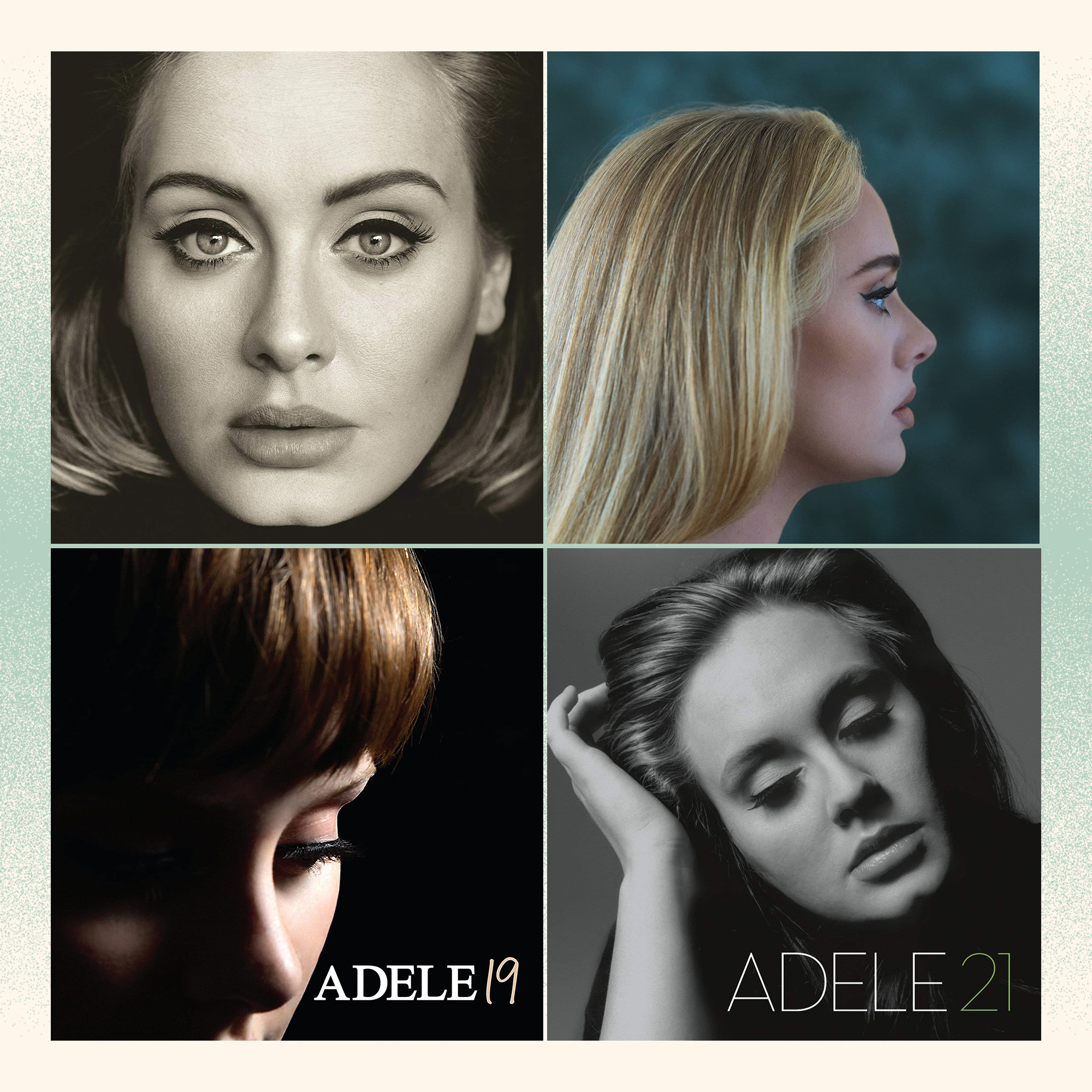
Make You Feel My Data
Text Analysis on Adele’s Catalog
Who is Adele?
Adele stands as a luminary whose soulful voice and emotionally charged lyrics have captivated the hearts of millions worldwide. Her music is often described as transcending time and genre, resonating with listeners on a deeply personal level. Beyond the her melodies and emotionally resonant lyrics, this data analysis takes a look at Adele’s discography, utilizing the Spotify API to quantify the sentiments encapsulated within her lyrics and to understand the emotional valence present in each of her songs across her remarkable career.
Examining Adele’s complete musical catalog, without considering album distinctions, reveals that her musical valence style, a metric reflecting a track’s emotional positivity, tends to gravitate towards sadness or melancholy, with an average valence of approximately 0.36. Nevertheless, her discography displays significant fluctuations in valence, as depicted in the stretched density plot below, which spans nearly the entire valence scale. This variation indicates that while the mean valence is 0.36, there is a notable standard deviation of 0.2. It’s essential to keep in mind that valence is a metric constrained within the range of 0 to 1.
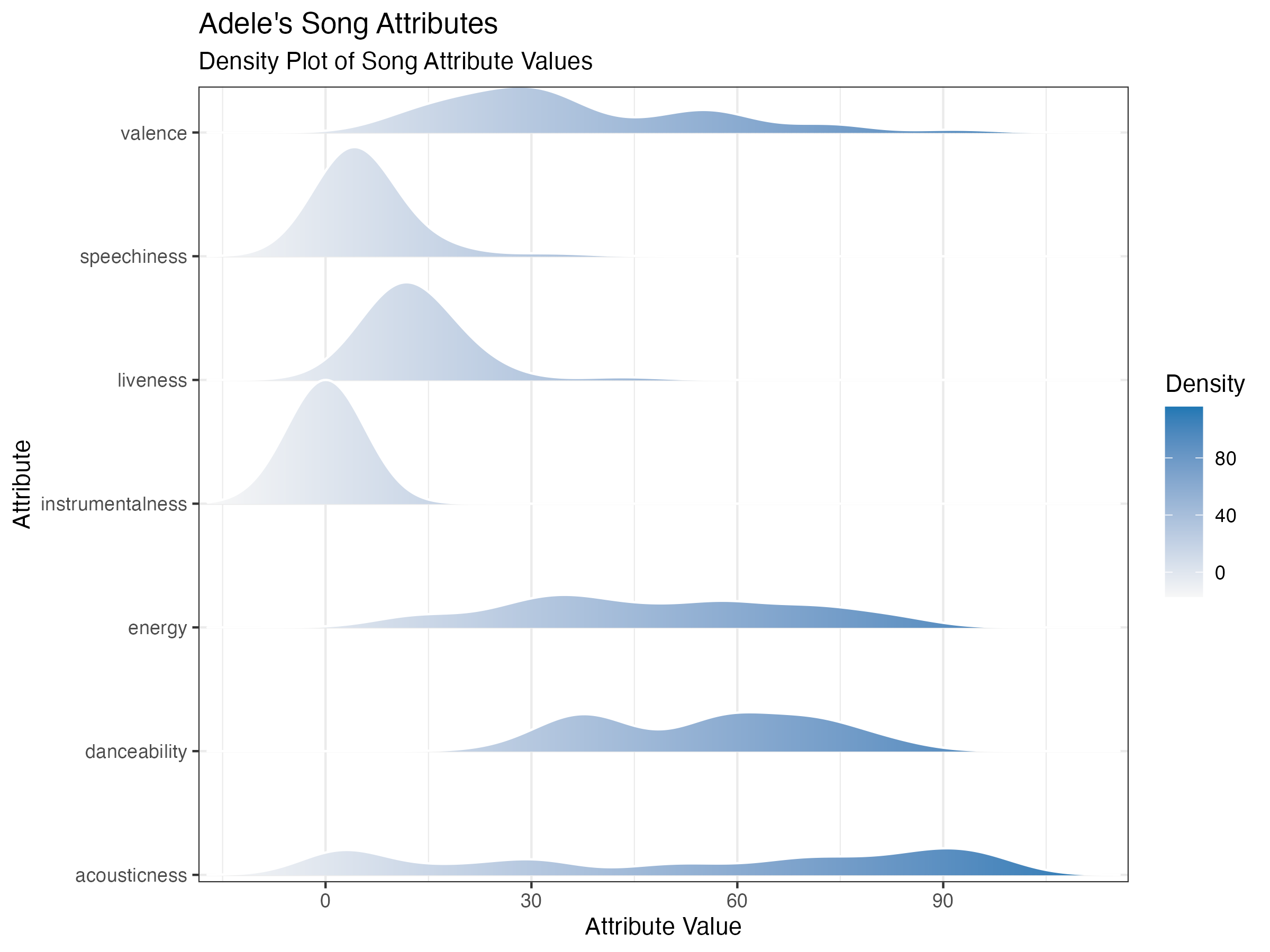
The presence of stretched density plots in multiple dimensions of Adele’s musical catalog offers a glimpse into the diversity of her music style. Alongside valence, we observe a similar phenomenon in metrics like acousticness, danceability (albeit to a lesser extent), and energy. These stretched density plots, which span various ranges within their respective metrics, indicate a wide spectrum of experiences within Adele’s discography.
For instance, the acousticness plot showcases a broad range of soundscapes, from stripped-down, acoustic melodies to more heavily produced tracks. The danceability plot, while exhibiting a smaller range, suggests a subtle exploration of rhythmic elements in Adele’s music, reflecting her ability to experiment with different tempos and grooves. Meanwhile, the energy plot unveils dynamic shifts in the intensity and vigor of her songs, highlighting her skill in crafting emotionally charged ballads as well as more upbeat and energetic compositions.
Adele’s albums, each a musical chapter in her remarkable career, reveal subtle yet distinct differences in valence. From the heartfelt melodies of “19” and “21” with valence scores of 0.42 and 0.41, respectively, to the more introspective tones of “25” and “30” at 0.30 and 0.33, the evolution of Adele’s music is evident in the changing emotional landscapes she navigates throughout her albums. These valence scores offer a glimpse into the evolving narrative of her music, capturing the essence of her emotional journey as it unfolds across the years.
| Album | Mean_Valence | Mean_Speechiness | Mean_Liveness | Mean_Instrumentalness | Mean_Energy | Mean_Danceability | Mean_Acousticness |
|---|---|---|---|---|---|---|---|
| 19 | 0.42 | 0.08 | 0.12 | 0 | 0.40 | 0.63 | 0.62 |
| 21 | 0.41 | 0.04 | 0.12 | 0 | 0.53 | 0.58 | 0.44 |
| 25 | 0.30 | 0.04 | 0.15 | 0 | 0.50 | 0.50 | 0.37 |
| 30 | 0.33 | 0.07 | 0.14 | 0 | 0.48 | 0.51 | 0.59 |
What is Adele Saying?
While valence is an important metric in measuring the overall emotional tone of Adele’s music, it only scratches the surface of the emotional narratives she weaves through her lyrics. To fully appreciate the depth of her artistry, it’s essential to look at the very essence of her compositions – the words and sentiments she pours into her songs. In a text analysis of her lyrics, I utilze the Bing sentiment lexicon, a well-established resource in the field of natural language processing and compare word sentiment across her albums. The Bing sentiment lexicon assigns sentiment scores to individual words, categorizing them as positive, negative, or neutral based on their inherent emotional connotations. By utilizing this lexicon in R, I can quantitatively assess the rich emotional content that forms the backbone of Adele’s discography.
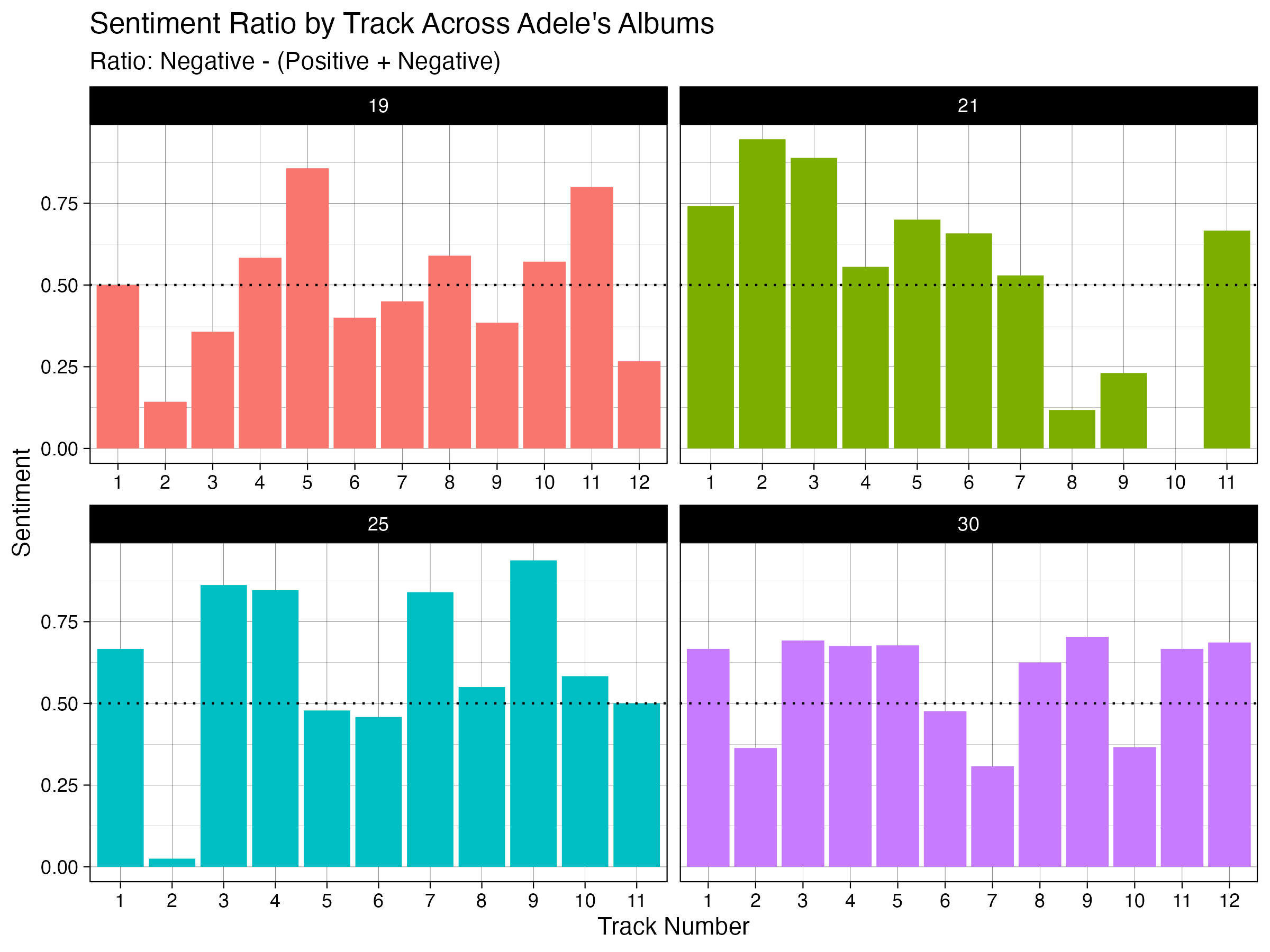
On a closer examination of Adele’s albums through the lens of sentiment analysis, a fascinating pattern emerges. While it may appear that each album’s sentiment, as expressed through its lyrics, tends to skew more towards the negative side on average, it’s intriguing to note that a common thread prevails—the sentiment ratios often hover around the neutral point of 0.5. This observation hints at Adele’s remarkable ability to craft songs that encapsulate a wide spectrum of emotions, delving into the depths of vulnerability and melancholy while maintaining a sense of emotional balance. Despite the varying degrees of negativity in her lyrical content across albums, the sentiment ratios converge around this equilibrium, reflecting the universality of her music and its ability to resonate with listeners who find solace in her emotive storytelling. It’s a testament to Adele’s artistry that her songs, despite their poignant narratives, manage to strike a harmonious emotional chord that goes beyond the boundaries of individual albums.
Mapping Adele’s Catalogue
Adele’s discography is an emotional journey, a narrative of heartache, introspection, and resilience. What stories does Adele tell through her music? How does her style evolve from album to album? To answer these questions, we return once again to valence and energy.
At the intersection of musical analysis and psychology, our examination of Adele’s songs through a scatter plot of energy and valence draws inspiration from the Two-Factor Theory of emotion. This approach aligns with the theory’s core principle, suggesting that emotions emerge from the interplay of physiological arousal and cognitive interpretation. In the musical context, energy represents the physiological aspect, mirroring the dynamism and visceral qualities of each composition. Valence, on the other hand, encapsulates the cognitive component, reflecting the emotional tone—whether it leans towards positivity or negativity. By applying the Two-Factor Theory to Adele’s discography, we can plot the melodic, lyrical intricacies, and the emotional narratives that are embedded in her music.
*if viewing on mobile, rotate your phone horizontal to enhance your experience with the interactive plot*