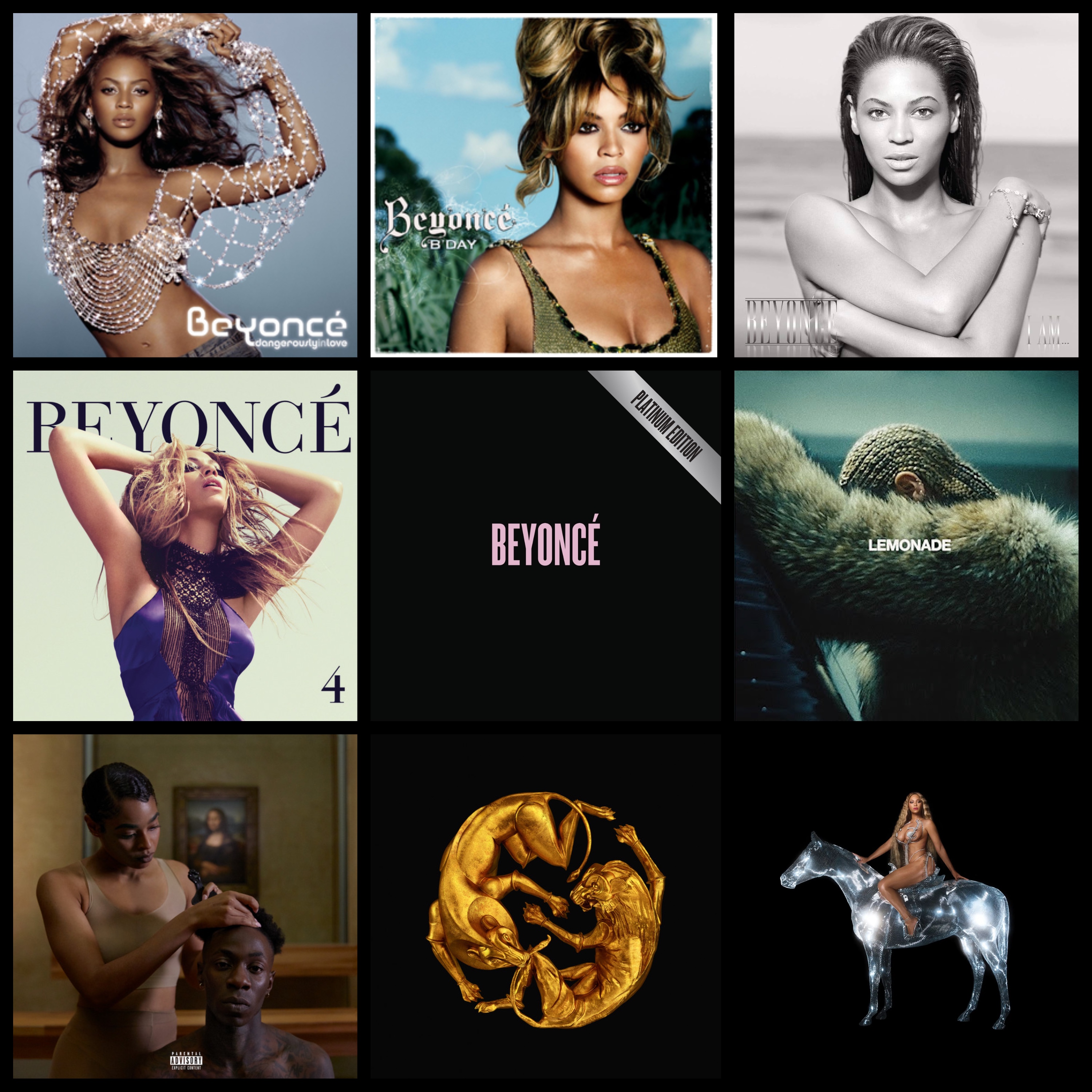
Mother of the House
Analysis On What Makes the Queen, One of One
In the realm of entertainment, few names resonate as powerfully as Beyoncé Knowles-Carter. The global icon has not only redefined the music industry but has become a symbol of empowerment, creativity, and cultural influence. In this data-driven exploration, I use the Spotify API1 to pull information on all of Beyoncé’s original albums– and, from there, I dissect the intricacies of her musical identity. I examine her streaming metrics to identify her most popular album, investigate the emotional and sonic breadth of her musical style, and analyze how the different elements of her music contribute to her top-of-the-charts streaming performance. Beyoncé’s discography is not just a journey through melodies; it’s an exploration of sonic evolution, genre-defying creativity, and a profound influence on the global music landscape2.
RENAISSANCE: Most Streamed Album
Let’s first start by looking at the popularity of the Queen’s songs and albums. The visualization below depicts the distribution of log streams per album3, shedding light on the distinct patterns of listenership across her prolific career. “RENAISSANCE” claims the throne as Beyoncé’s most streamed album on average. Though there may be individual songs from other albums that have higher listenership, what truly distinguishes “RENAISSANCE” is not just its staggering popularity but also the intriguing consistency in streaming numbers across its tracks. Many of her albums, such as “Dangerously in Love” and “I AM…SASHA FIERCE”, have a number of stand-out hits but, also, a number of songs with comparatively far fewer streams. (Though, because we’re still talking about Beyoncé, even relatively low performing song can have millions of streams). The streaming metrics in “RENAISSANCE”, however, are more tightly clustered and don’t feature any individual songs that is dramatically below the album’s average number of streams.
One way to demonstrate this, mathematically, is to look at the variance in her song streams. The variation in “RENAISSANCE”’s streaming values (σ2 = .44) is only a fraction of that of “Dangerously in Love” (σ2 = 2.79) or “I AM… SASHA FIERCE,” (σ2 = 2.16). Indeed, it has the lowest variance of all her studio albums that I analyze here.
This between streams suggests a compelling narrative—it’s likely that listeners are immersing themselves in “RENAISSANCE” as a cohesive body of work rather than focusing on individual singles. Unlike most of her previous albums, characterized with high peaks but low-lows, it appears likely that many fans are savoring the entirety of “RENAISSANCE” from start to finish. This is a rarity in the age of on-demand music streaming. This phenomenon not only attests to the enduring allure of Beyoncé’s musical artistry but also underscores the album’s capacity to captivate audiences in a continuous, uninterrupted flow.
*if viewing on mobile, rotate your phone horizontal to enhance your experience with the interactive plot*
This led me to wonder whether the uniqueness of “RENAISSANCE” was due to its proximity to when Beyoncé started putting albums more on Spotify rather than on Tidal. Maybe this, combined with “RENAISSANCE”’s Spotify release-date, made it more likely for people to return to older works and focus only on the highlights and singles they remembered from the days prior to streaming? Using a linear mixed-effects model (featuring a random intercept for each album to account for album-specific variations in streaming behavior), I found there to be no statistically significant difference in the number of log streams between albums released before or after Spotify. This after controlling for other relevant things that, as I’ll show later, have the potential to affect an individual single’s performance, such as valence’, ‘danceability’, ‘energy’, ‘loudness’, ‘speechiness’, ‘acousticness’, ‘instrumentalness’. The results from this model underscores that ‘RENAISSANCE’ continues to captivate audiences in a unique way regardless of its release date.
*if viewing on mobile, rotate your phone horizontal to enhance your experience with the interactive plot*
Mapping Beyoncé’s Discography
Beyoncé’s discography is a rich tapestry woven with diverse themes, from empowerment anthems to soulful ballads. The Spotify API delivers more than just raw streaming values: it also provides a quantitative estimate of a song’s “energy” and “valence”. These features adds a layer of depth to our analysis rooted in the Two-Factor Theory of emotion. According to this theory: emotions arise from a combination of physiological arousal and cognitive interpretation. In the musical context, energy serves as a proxy for the physiological arousal, reflecting the dynamic and visceral qualities of each composition. Valence encapsulates the cognitive dimension, indicating the a positive or negative emotional tone. Using these measures, I delve into the nuances of her songwriting and production choices. Are there discernible patterns in the types of songs she creates? How do her albums vary in terms of style and thematic content?
Looking at the chart below, we see that the majority of Beyoncé’s discography is characterized by high-energy music—but the emotion behind these songs span the full range of Spotify’s scale. At the far end, in the Upbeat/High Energy section, we see stand-out anthems like “Run the World (Girls)” “MY POWER”, and “BREAK MY SOUL.” But on the Melancholic side of the scale, we see songs like “CHURCH GIRL”, “That’s why you’re beautiful”, and “I care.” That’s not to discount the powerful songs that she produces on the lower-energy part of the scale—almost all of which are melancholic.
We can also see that entire albums carry different emotional profiles. “RENAISSANCE” doesn’t have a song that dips below the half-way mark on Spotify’s energy scale, whereas the majority of songs from “Dangerously In Love” do. “Lemonade”, perhaps predictable, is mostly melancholic but ranges dramatically in its energy.
By applying the Two-Factor Theory of Emotion to Beyoncé’s discography, we see not only the rhythmic and melodic intricacies but also the emotional narratives embedded in her music—as well as the diverse emotional range at her command.
*if viewing on mobile, rotate your phone horizontal to enhance your experience with the interactive plot*
Valence, is a measure from 0.0 to 1.0 describing the musical positiveness conveyed by a track. Tracks with high valence sound more positive (e.g. happy, cheerful, euphoric), while tracks with low valence sound more negative (e.g. sad, depressed, angry).
Energy is a measure from 0.0 to 1.0 and represents a perceptual measure of intensity and activity. Typically, energetic tracks feel fast, loud, and noisy while less energetic tracks feel slower or mellower. Perceptual features contributing to this attribute include dynamic range, perceived loudness, timbre, onset rate, and general entropy.
What Makes a Song Soar in the BeyHive?
Finally, we look at other acoustic elements that Spotify calculates to see how these vary in her music and, also, how well they predict each songs’ streaming performance.
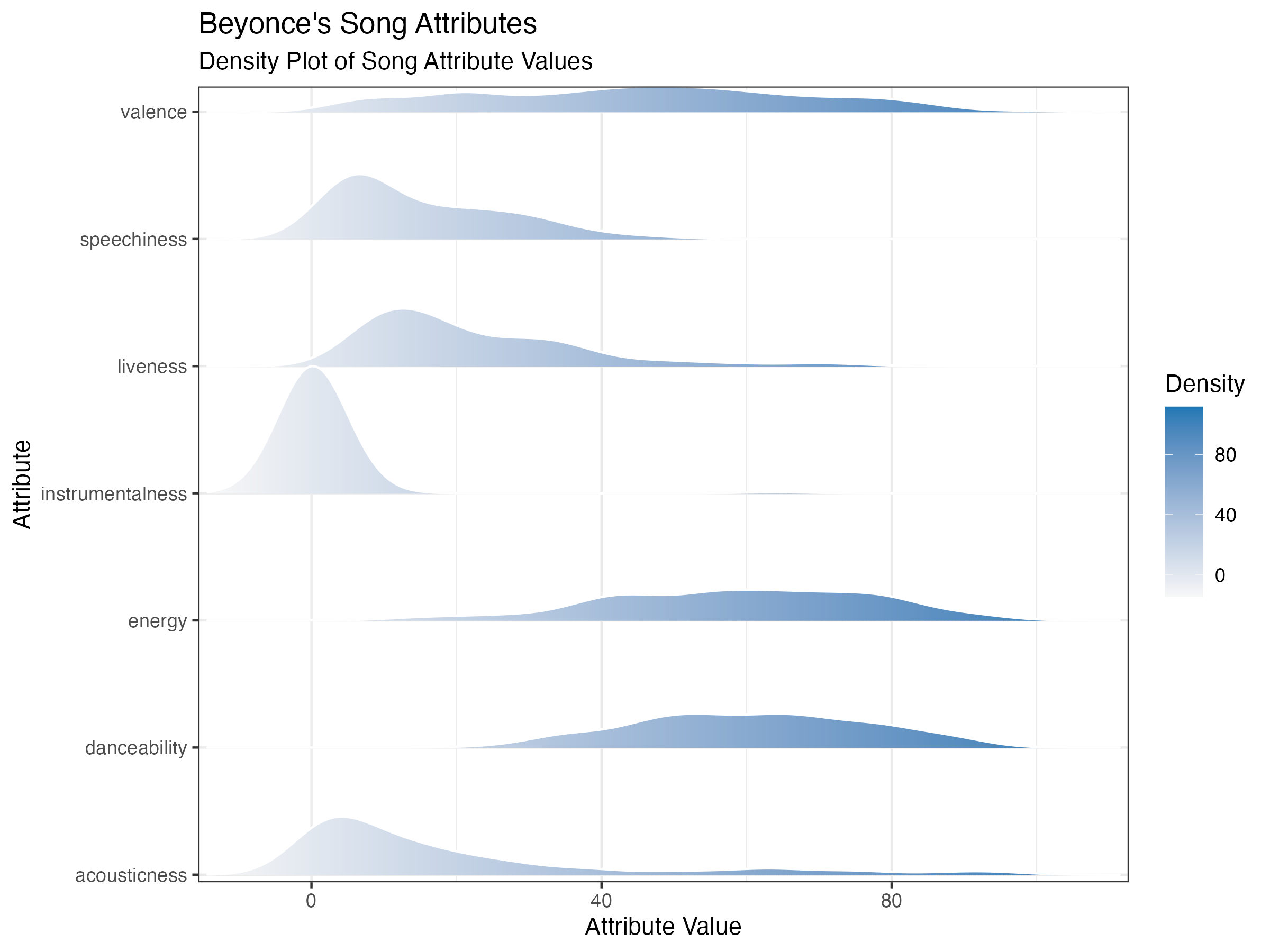
Beyoncé’s music is a captivating blend of elements that sets the stage for dance enthusiasts worldwide, with an average danceability score of around 0.61. Her tracks are finely tuned for the dancefloor, featuring an infectious rhythm, strong beats, and a tempo that invites listeners to groove. Beyond the rhythm, Beyoncé’s vocal prowess shines brightly in her discography. While her instrumentalness score indicates the presence of vocals, it’s her powerful and versatile voice that truly defines her artistry, allowing her to convey a wide spectrum of emotions through her singing. Her music seamlessly traverses a range of feelings, with an average valence score of approximately 0.45. From moments of euphoric positivity to introspective depths and even touches of raw emotion, Beyoncé’s ability to explore the multifaceted aspects of the human experience makes her discography a compelling journey through a diverse emotional landscape.
But when it comes to Beyoncé’s music, what sets certain songs soaring while others receive less attention? To help answer this question, I used a Random Forest model to unveil the crucial factors that shape the popularity of her music. Random Forests are a type of machine learning algorithm used in classification and prediction problems and are particularly useful when we expect there to be complex, non-linear relationships between predictors and the thing they are intended to predict. As we’ve seen from the analysis thus far, Beyoncé’s music spans wide sonic, emotional, and performance ranges. A good song is more than the mere sum of its musical and lyrical parts: these elements come together in complex ways. In short, Random Forests, with their higher performance for non-linear predictive tasks, are excellently suited for mapping music characteristics to streaming performance.
Notably, ‘loudness:acousticness’ (meaning the interaction of loudness and acousticness) emerges as the most influential feature in the Random Forest model, displaying a strong interaction between the volume and acoustic elements in her music. Despite Beyoncé’s relatively low mean acousticness value of around 0.19, this finding suggests that when her music incorporates acoustic nuances, they become standout moments that significantly impact streaming popularity.
‘Danceability interacted with energy’ closely follows in importance, reaffirming the importance of vibrant rhythms and musical vitality in captivating her audience. ‘Speechiness interacted with acousticness’ underscores the blend of lyrical clarity and acoustic qualities as a driving force behind her most-streamed songs. The dynamic interplay between ‘energy interacted with speechiness’ and ‘energy interacted with tempo’ adds layers of depth to her music’s appeal, highlighting the balance between intensity, tempo, and vocal delivery.
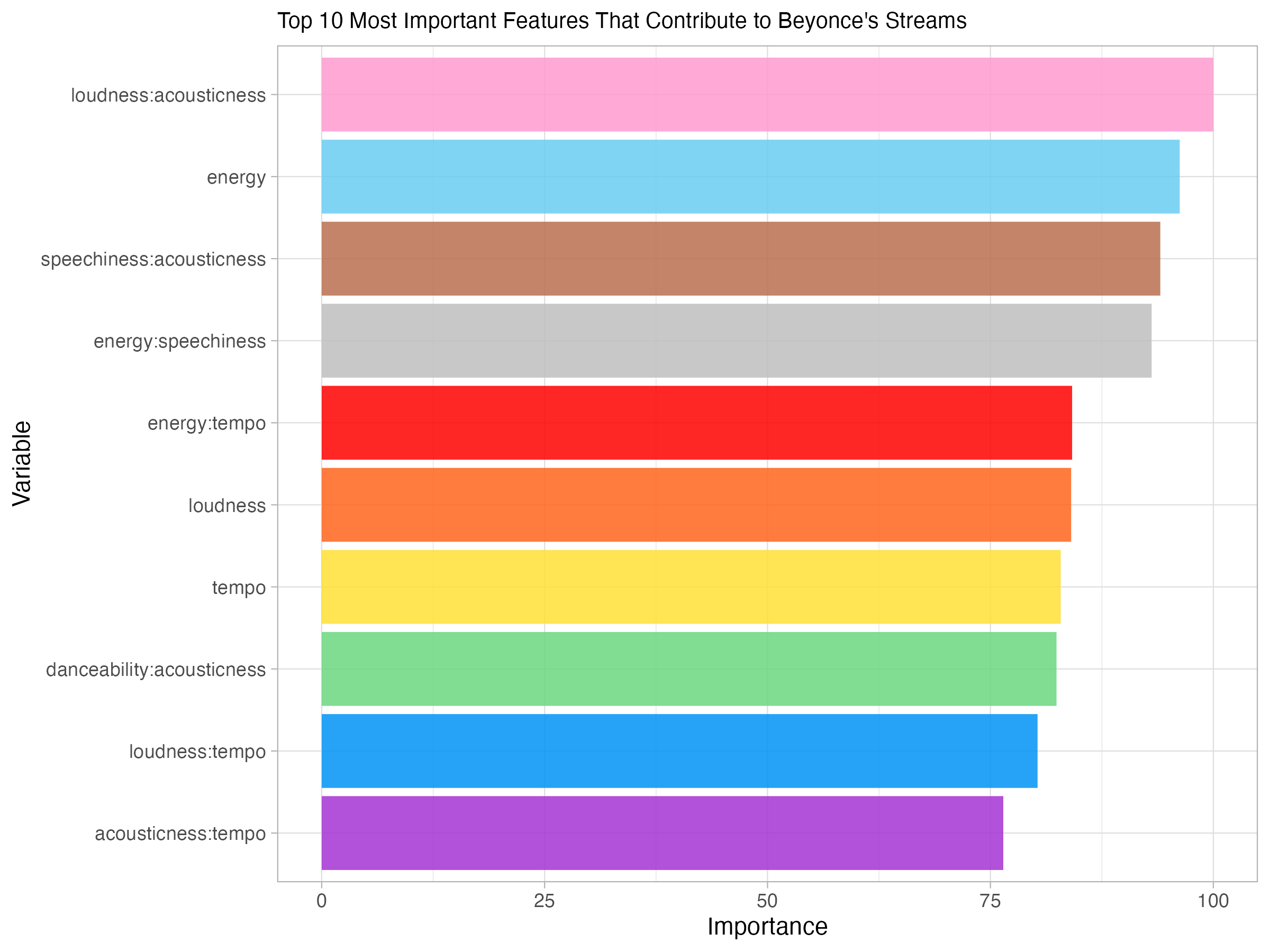
These findings collectively reveal that Beyoncé’s fans, affectionately known as the Hive, are drawn to songs that offer a harmonious fusion of these elements. It becomes evident that her ability to navigate diverse musical styles, incorporate acoustic nuances strategically, and deliver emotionally charged vocal performances contributes significantly to her unparalleled streaming success.
Conversely, the analysis unveils the less impactful features in Beyoncé’s song streams, primarily centered around instrumental aspects. ‘Instrumentalness interacted with valence’ claims the lowest position, emphasizing the audience’s preference for songs featuring vocal and emotional elements over purely instrumental compositions. ‘Acousticness interacted with instrumentalness’ and ‘loudness interacted with instrumentalness’ follow suit, indicating that Beyoncé’s vocal prowess and storytelling take precedence among her listeners.
In essence, these least impactful features point to the audience’s inclination towards vocal and lyrical elements, suggesting that Beyoncé’s vocal mastery and storytelling play a significant role in the appeal of her music. While instrumental aspects are not entirely dismissed, it’s clear that vocal and emotional dimensions take precedence among her listeners, aligning with the artist’s celebrated vocal talents and captivating storytelling abilities.
Footnotes
Song streams and metrics were pulled from Spotify in January 2024.↩︎
It’s important to note that in the data cleaning process, certain decisions were made to ensure the integrity of the analysis. ‘Homecoming: The Live Album’ was removed to eliminate duplicate songs. Additionally, any song on which Beyoncé did not provide vocals on in any of her albums, primarily ‘The Lion King: The Gift [DELUXE],’ were excluded. The focus was primarily on studio albums and songs in which Beyoncé served as a vocalist, not just as a songwriter. For example, songs like ‘MY POWER’ were retained in the analysis, while ‘JA ARA E’ was removed. Finally, “Beyonce Interlude” from Dangerously In Love, a 0:16 second interlude, was also removed from the analysis as well.↩︎
I transformed these metrics onto a log scale due to the large span of values these streaming metrics can take. This is due to the evolving popularity of Beyoncé as an artist, and of streaming as a way of consuming music. Charting metrics on a log scale helps simplify visualizations, allowing us to more easily see patterns in the data that could otherwise be missed by the large overall span of values.↩︎