Two Speeches. Two Americas.
Sentiment Analysis of Harris and Trump’s Nomination Speeches
Abstract
In the charged atmosphere of American political conventions, a candidate’s speech serves as a powerful tool for shaping public perception and rallying support. This Article examines the contrasting rhetorical approaches of Kamala Harris and Donald Trump, the 2024 presidential nominees, through a detailed sentiment analysis of their convention speeches. Using the BING lexicon to analyze individual word sentiment and the VADER library to map emotional shifts over time, the Article looks at the differing strategies employed by each candidate.
In the annals of American political theatre, few environments offer candidates the platform necessary to capture the spectacle of their personality, positions, and oratory prowess than the Democratic and Republican National Conventions. These conventions occur every presidential cycle to nominate a candidate for president of the United States, ultimately serving as each candidate’s largest opportunity to sell themselves to the nation.
While these prime-time televised events enjoy grandiose moments of spectacle and fanfare, the closing of these events is marked by highly anticipated speeches by each of the nominees. These speeches are not mere addresses; they are meticulously curated performances designed to reinforce the nominees’ image and galvanize supporters. The linguistic landscape, both in sentiment and word choice, helps define each candidate’s oratory capabilities and provides insight into how each plan to lead their party—and, by extension, the nation.
On the Democrats’ side, Kamala Harris1, their nominee for president, has emerged as a skilled orator whose speeches are marked by clarity, poise, and precision. As the first woman of color to lead a major party ticket, Harris delivers her messages with a blend of personal warmth and prosecutorial sharpness that has become her hallmark. Her rhetoric often emphasizes themes of justice, equality, and collective progress, seamlessly weaving personal anecdotes with broader calls to action. Harris’s speaking style is direct and deliberate, aiming to connect with a diverse coalition of voters by addressing both their shared values and specific concerns. Her speeches are carefully crafted to reflect a message of unity and a commitment to upholding democratic principles, presenting her as a steady and empathetic leader in contrast to the more combative style of her opponent.
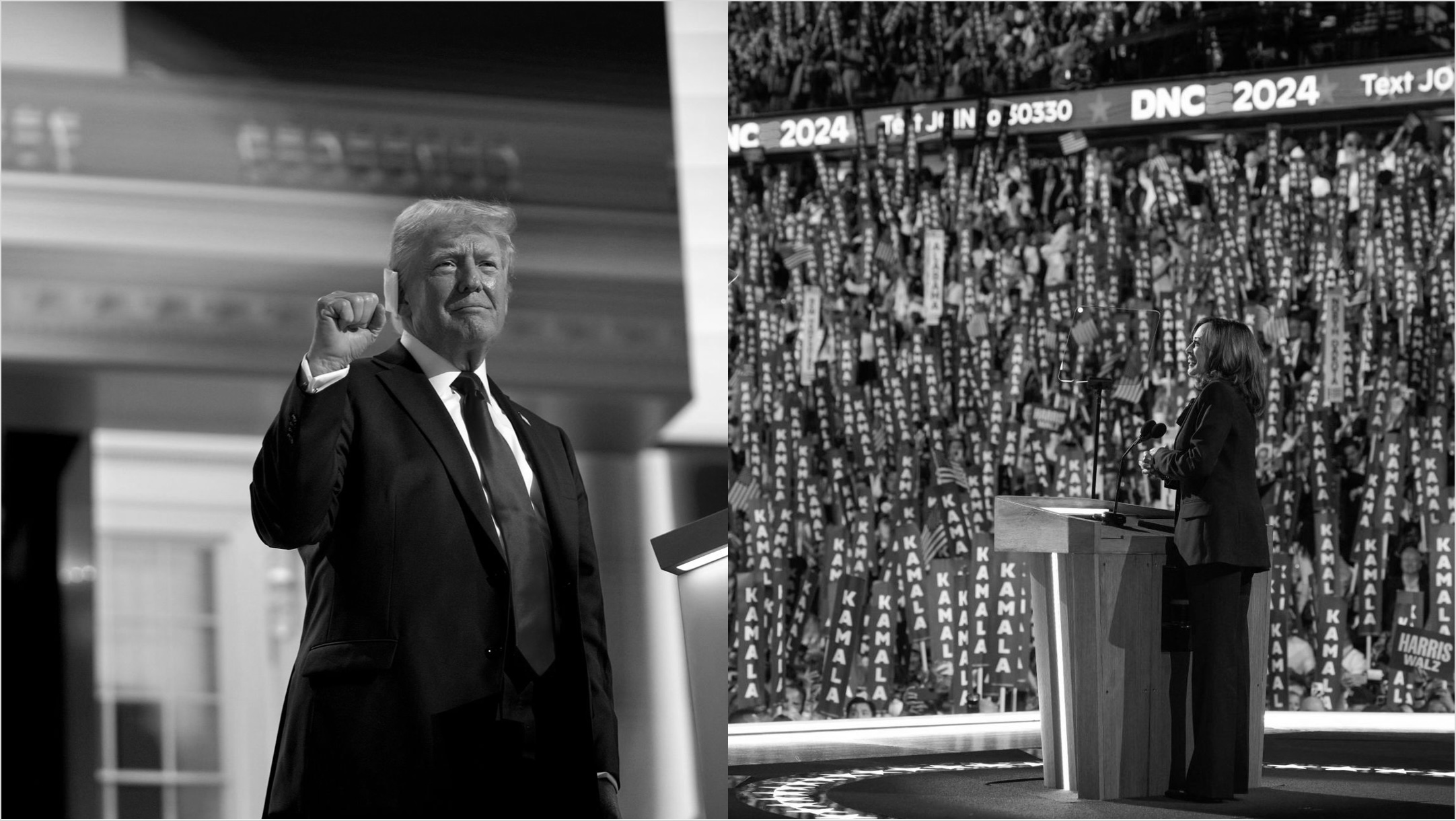
In contrast, few figures have commanded the stage with the same intensity and spectacle as the 2024 Republican nominee for president, Donald Trump2. His rhetoric—fiery, unyielding, and deeply resonant with his base—has been a cornerstone of his political persona. His remarks can often be littered with digressions and hard-to-navigate tangents, weaving through a maze of personal anecdotes, off-the-cuff remarks, and rhetorical flourishes that can leave his audience simultaneously captivated and bewildered. Trump’s speeches are designed to energize his supporters by invoking themes of conflict, adversity, and resilience, aiming to position himself as the singular leader capable of confronting the challenges he outlines.
Vocabulary of Victory: Freedom vs. Trump
The 2024 nomination speeches from Trump and Harris present a striking contrast in both tone and thematic focus, as reflected in their language. Analyzing sentiment and frequency of words in their speeches reveals not only the candidates’ differing rhetorical style but also their distinct approaches to defining the stakes of the upcoming election3.
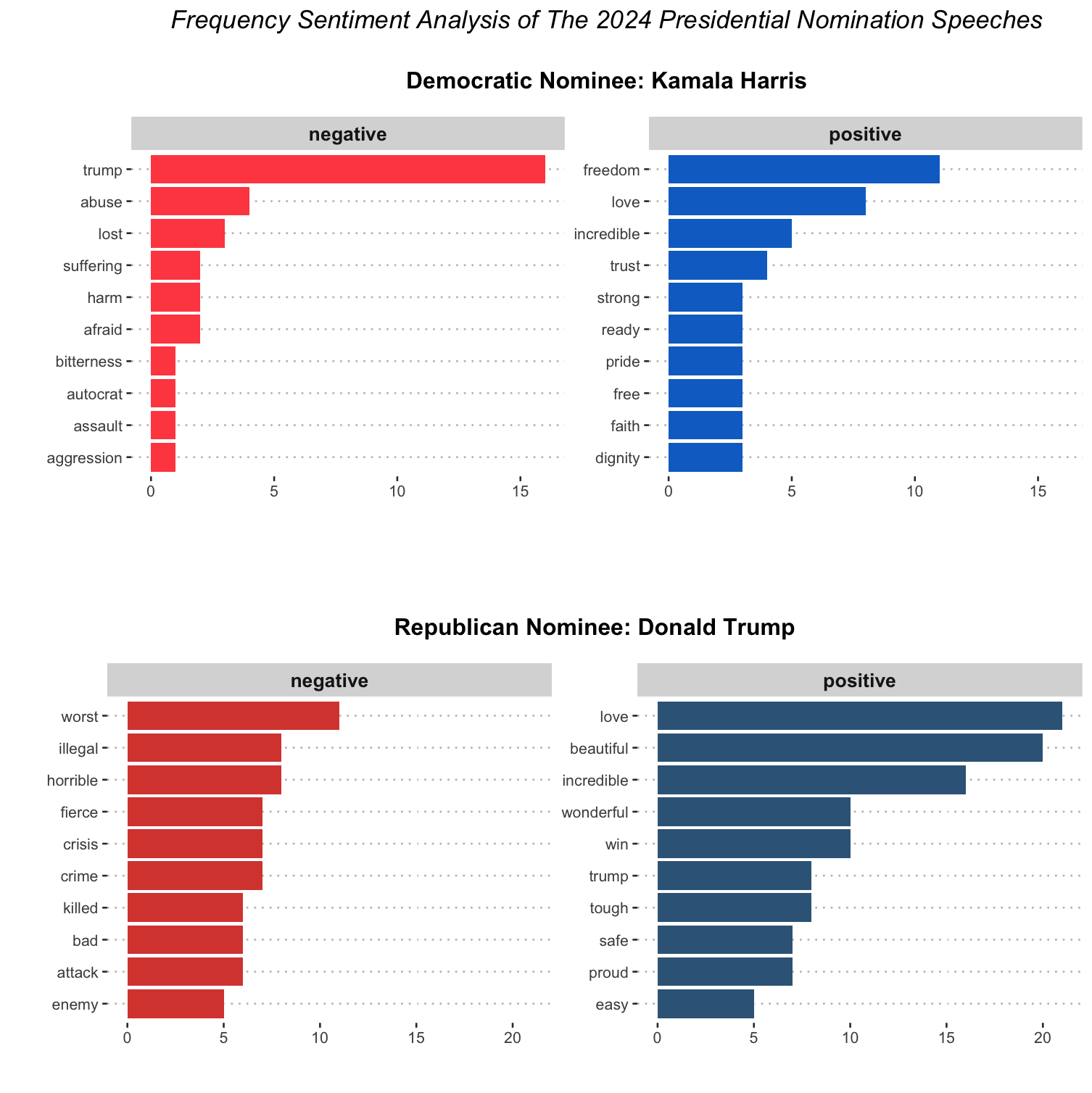
Harris’s speech is carefully crafted to emphasize themes of unity, resilience, and social justice while casting Donald Trump as a direct threat to democratic norms. The most frequently occurring negative word in her speech is “Trump,” underscoring her strategy of framing the election as a referendum on his presidency. By focusing on words like “abuse,” “harm,” and “suffering,” Harris not only critiques Trump’s leadership but also highlights the systemic issues she aims to address. Her positive language, featuring words such as “freedom,” “love,” and “incredible,” seeks to promote a vision of inclusivity and progress, appealing to a broad coalition of voters who are eager for stability and compassionate leadership in turbulent times.
Conversely, Trump’s speech employs emotionally charged language with frequent references to conflict and adversity. He uses negative words like “worst,” “illegal,” “horrible,” and “crisis” to paint a picture of an America besieged by problems that only his leadership can solve. His positive words—“love,” “beautiful,” “Trump,” and “incredible”—serve to evoke patriotic pride and personal admiration, reinforcing his image as a strong, indispensable leader. This dichotomy of fear and admiration is central to Trump’s rhetorical strategy, designed to energize his base with a blend of dire warnings and self-aggrandizing affirmations.
Both candidates’ speeches tap into the psychological impulses that drive voter behavior but do so in starkly different ways. Harris appeals to empathy and a shared desire to protect commonplace values – “freedom”, “dignity,” and “faith” – from further erosion, positioning herself as a stabilizing force against Trump’s perceived chaos. Trump, on the other hand, seeks to elicit a visceral, almost primal response from his supporters by portraying a nation under siege and positioning himself as the sole protector against myriad threats. This divergence in strategy reveals their distinct calculations about the psyche of the American electorate: Harris’s inclusive, future-oriented message contrasts sharply with Trump’s combative call to arms, setting the stage for a profound clash of visions for the country’s future.
Rhythmic Divergence: Kamala’s Consistency vs. Trump’s Variability
If words are the building blocks of political rhetoric, then the true art of oratory lies in how those words are arranged, paced, and deployed over time. It’s not just what is said, but when and how that truly resonates with an audience, stirring emotions, and shaping perceptions. By analyzing the sentiment of each paragraph in the speeches of Kamala Harris and Donald Trump using the VADER4 sentiment analysis tool, we gain deeper insights into the emotional choreography of their performances.
Kamala Harris’s speech at the Democratic National Convention was a masterclass in disciplined oration—a precise, tightly woven narrative that left little room for ambiguity or doubt. Through each paragraph, Harris constructed a cohesive portrait of who she is, where she comes from, and what she stands for. Her speech was filled with personal stories and appeals to shared values, presenting her as a relatable and credible figure on the national stage. The VADER sentiment analysis underscores this approach: her speech is marked by consistent waves of positive sentiment, with blue bars frequently reaching upward as she speaks of hope, resilience, and a collective American identity. It’s a steady rhythm, one that reinforces her image as a focused, capable leader who knows where she’s headed and is determined to bring the country along with her.
But Harris’s speech wasn’t just about positivity. Interspersed among her uplifting passages are sharp, targeted critiques—moments where the red bars of negative sentiment pierce through, signaling her warnings about Donald Trump and the dangers she believes his leadership poses to American democracy. These are not meandering attacks; they are deliberate, purposeful jabs, designed to cast Trump as a chaotic force, an aberration from the democratic norms she vows to protect. Unlike Trump, who often wanders into tangents and lengthy diatribes, Harris’s speech is economical—each word carefully chosen, each phrase serving a strategic purpose. In her speech, there are hardly any wasted sentences; each one is a building block in her portrayal of herself as a disciplined, decisive leader, ready to command from day one. At just about 40 minutes, her speech was a model of focus and brevity compared to her opponent’s more protracted performance.
*if viewing on mobile, rotate your phone horizontal to enhance your experience with the interactive plot*
In contrast, Donald Trump’s speech at the Republican National Convention unfolded in a markedly different style. He opened with an uncharacteristic attempt at unity, promising to bridge the political divides he has often been accused of deepening. At moments, his rhetoric seemed to echo tones more akin to Barack Obama’s message of hope and healing than to the dark vision of America that characterized his previous nomination speeches. “The discord and division in our society must be healed — we must heal it quickly,” Trump said, attempting to strike a conciliatory tone. “As Americans, we are bound together by a single fate and a shared destiny. We rise together — or we fall apart.”
However, even as Trump’s address aimed to debut a more unifying message, his characteristic lack of discipline soon emerged. What began as a structured speech slowly unraveled into a sprawling monologue, extending well beyond 90 minutes—the longest Republican nomination address since at least 19565. As time wore on, his initial adherence to the script gave way to the familiar, unscripted ramblings that have become a hallmark of his public speaking. In contrast, Harris delivered a concise, focused address, clocking in at just 40 minutes. Where Trump tested the patience of his audience with length and unpredictability, Harris’s speech was an exercise in brevity and discipline.
*if viewing on mobile, rotate your phone horizontal to enhance your experience with the interactive plot*
To this end, the rhythms of their speeches reveal much about their broader campaign narratives: Harris’ address, with its steady cadence and structured approach, underscores her vision of cohesive and stable governance. Her use of language is deliberate, even when she goes on the offensive. Harris frequently invokes Trump’s name as a symbol of what she argues is a fundamental threat to democratic norms and social progress. These negative references are not scattered haphazardly but are strategically clustered, forming distinct blocks on her sentiment map. This methodical deployment of criticism suggests a disciplined strategy aimed at casting Trump as a singular adversary whose defeat is necessary for national healing and progress. Her rhetoric flows in a measured way, much like her proposed governance style—steady, reliable, and focused on unity and forward movement.
Trump’s speech, by contrast, is a study in volatility. His sentiment map is erratic, mirroring the unpredictability of his speech patterns and, by extension, his approach to leadership. He oscillates wildly between stark warnings of doom and exuberant self-praise, creating a jarring, roller-coaster experience for his listeners. This unpredictable rhythm aligns with his campaign’s emphasis on strength and resilience in the face of myriad threats—be they from political opponents, the media, or perceived external adversaries. Where Harris seeks to offer stability and clarity, Trump thrives on creating a sense of urgency and confrontation. His speech’s emotional turbulence is designed to galvanize his base, reinforcing his image as a bold, unyielding leader willing to tackle the nation’s problems head-on, no matter how chaotic the path.
The contrast between Harris’s methodical approach and Trump’s erratic style offers a window into their respective campaign strategies. Harris appeals to voters yearning for calm, coherent leadership and a return to democratic norms, positioning herself as a unifying figure capable of guiding the country through turbulent times. Meanwhile, Trump’s speech reflects a campaign that embraces chaos and conflict, seeking to rally his supporters with a potent mix of fear, loyalty, and defiance. This stark divergence in rhetorical strategies—Harris’s structured critique and hopeful vision versus Trump’s forceful, unpredictable narrative—underscores the fundamental choice facing the American electorate in 2024: a vote for steadiness and freedom or a vote for drama and confrontation.
Footnotes
Full Transcript of Kamala Harris’s Democratic Convention Speech: https://www.nytimes.com/2024/08/23/us/politics/kamala-harris-speech-transcript.html↩︎
Full Transcript of Donald Trump’s Republican Convention Speech: https://www.nytimes.com/2024/07/19/us/politics/trump-rnc-speech-transcript.html↩︎
In this section, I utilize the Bing lexicon for sentiment analysis, which assigns a binary sentiment classification—either positive or negative—to individual words. This approach simplifies sentiment measurement by categorizing words based on their inherent connotations, allowing for straightforward counting of sentiment-bearing words. The Bing lexicon is particularly useful for analyzing the overall sentiment distribution in a speech by tallying the frequencies of positive and negative words. This can help provide a snapshot of the general tone and rhetorical strategy employed by the speaker. While Bing does not capture sentiment intensity or contextual nuances, it is ideal for tasks focused on identifying key themes and word frequency patterns, revealing how candidates frame their messages and appeal to their audiences.↩︎
The VADER (Valence Aware Dictionary and sEntiment Reasoner) library is effective for sentiment analysis in speeches due to its ability to evaluate both the intensity and direction of sentiment within text. Unlike the Bing lexicon, which categorizes words as simply positive or negative, VADER assigns each word a sentiment score ranging from -4 (extremely negative) to +4 (extremely positive). The overall sentiment score of a passage is then calculated as a normalized weighted sum of these scores, producing a compound score between -1 (most extreme negative) and +1 (most extreme positive). This compound score allows for a more granular analysis of sentiment fluctuations within a speech, capturing the nuances of tone, intensity, and rhetorical shifts. VADER also accounts for contextual amplifiers, such as punctuation and capitalization, which enhances its accuracy in assessing the complex emotional dynamics often present in political rhetoric.↩︎
The American Presidency Project: https://www.presidency.ucsb.edu/documents/presidential-documents-archive-guidebook/party-platforms-and-nominating-conventions-2↩︎