
The Re-Recording of Taylor Swift’s Masters
Are The Re-Recordings Faithful to the Originals?
Taylor Swift, the celebrated artist known for her chart-topping albums, has embarked on a remarkable journey in the music industry – the re-recording of her original albums. As this ambitious project unfolds, the question often posed is what is the difference between her originals and re-recordings? To tackle this task, I utilized various machine learning techniques and a dataset obtained through Spotify’s API.
The dataset consisted of a collection of 129 songs, each representing a distinct track from Taylor Swift’s discography. With such a modest sample size, the challenges were apparent from the outset. Importantly, the data was cleaned so that no song from Taylor’s Vault was included in the analysis. Every song on her original album had a counter re-recording on Taylor’s Version. The goal of the analysis was to develop a model capable of discerning between her original tracks and their re-recorded counterparts.
In this pursuit, I evaluated the performance on each model by assessing each method’s accuracy, sensitivity, specificity and F1-score. While accuracy often takes the spotlight as a measure of success, it can be a deceptive metric, as some methods may gravitate towards classifying everything as one category, as I observed in the case of SVM. In other words, if the model predicts every observation is from Taylor’s re-recordings, the model would thus have an approximate 50% accuracy, depending on how the data was partitioned. Therefore, my analysis extended beyond accuracy to consider sensitivity and specificity, collectively encapsulated in the F1 score. This holistic approach allowed me to assess not only the model’s ability to classify Taylor’s re-recordings but also its proficiency in recognizing her original compositions.
Amidst this evaluation, tree-based methods, such as Decision Trees and Random Forest, emerged as the front runners in this classification analysis. Their strong performance in the face of a relatively small sample size can be attributed to their unique capabilities. These methods partition the data into nested subsets, effectively mitigating over-fitting and enhancing generalization. Thus, they excel when working with limited data, providing robust and reliable results.
| Method | Accuracy | Sensitivity | Specificity | F1_Score |
|---|---|---|---|---|
| Logit | 0.32 | 0.12 | 0.48 | 0.13 |
| Decision Tree | 0.63 | 0.76 | 0.52 | 0.65 |
| Random Forest | 0.58 | 0.59 | 0.57 | 0.56 |
| SVM | 0.55 | 0.00 | 1.00 | NA |
| kNN | 0.45 | 0.12 | 0.71 | 0.16 |
Focusing specifically on my best performing model, Random Forest, an ensemble technique that combines the power of multiple Decision Trees to achieve exceptional classification accuracy, instrumentalness and acousticness emerge as the top two most important attributes in distinguishing between Taylor’s original and re-recorded tracks. On the other hand, key, speechiness, energy, valence, and tempo are revealed as the least important features in this context. This finding aligns with the expectation that re-recorded tracks are designed to closely mirror the originals, thereby minimizing variations in key, energy, valence, tempo, and other musical attributes. This insight sheds light on the distinctive characteristics of Taylor Swift’s re-recording project, where fidelity to the original composition takes precedence.
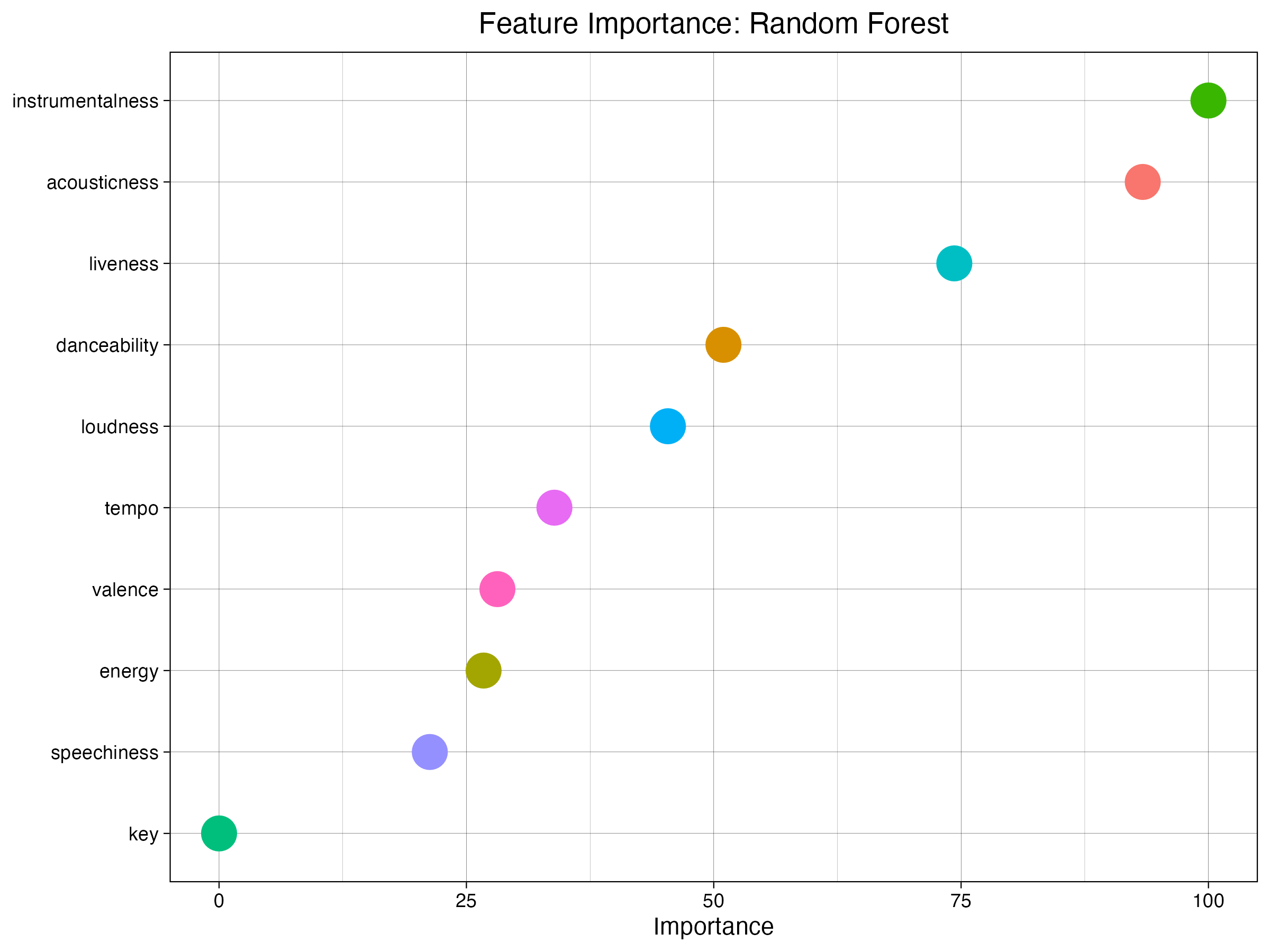
The significance of instrumentalness and acousticness in the classification task highlights distinctions between Taylor Swift’s original and re-recorded music. Instrumentalness is a metric predicting vocal presence in a track, ultimately discerning whether a composition contains minimal or no vocal content. As the instrumentalness value approaches 1.0, it signifies a higher likelihood of a track being predominantly instrumental (“Ooh” and “aah” sounds are treated as instrumental in this context). Notably, the model’s recognition of instrumentalness differences underscores that Taylor Swift’s re-recordings diverge from the instrumental essence of her original creations, resulting in marked vocal variations. Conversely, acousticness, a measure of confidence in a track’s acoustic nature, also plays a pivotal role in differentiation – where a score of 1.0 signifies high confidence in a track being acoustic.
The model suggests instrumentalness and acousticness are important features in distinguishing Taylor’s re-recordings from her originals. These distinctions not only highlight how her re-recordings diverge from her original creations, resulting in distinctive vocal and acoustic characteristics that set them apart but also challenge the notion of a 1-to-1 recreation. While the re-recordings have generally been marketed as faithful recreations of the originals, the model’s capacity to discern these differences efficiently and accurately suggests a fascinating complexity beneath the surface.
So, are Taylor’s Swift’s re-recordings faithful to the original? I leave that to you, the listener to decide. But if you ask the data, it appears the answer is resounding no.